 Community discounts for those who serve.


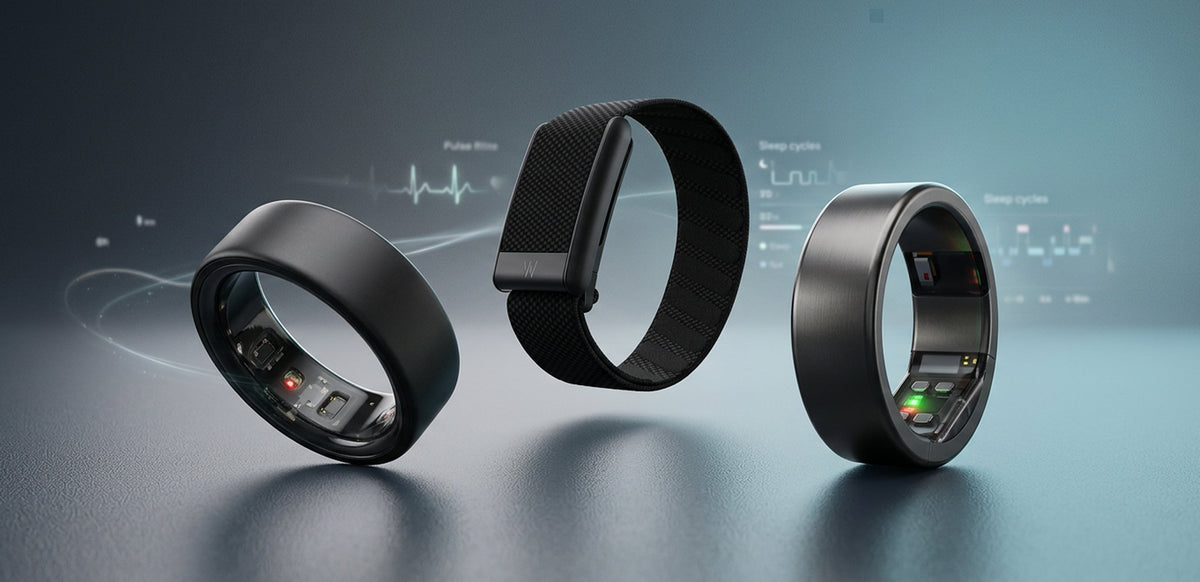
The new Ultrahuman ring lasted 20 days on one charge. Then it told me to go for a walk.
On October 22 I charged three wearables to 100% and put them all on. The Oura Ring 4 died on October 30. The Whoop MG died on November 5. The Ultrahuman Ring Pro kept going until November 11.
That is 8 days, 14 days and 20 days. Ultrahuman advertises up to 15.
Battery is the easy part to measure. The harder question is whether the new ring from Ultrahuman can match the two market leaders on the thing you actually buy a wearable for: telling you something true and useful about your body. I have worn an Oura ring for 9 years and a Whoop since 2020, so I had a baseline to compare against.
I wore all three, 24 hours a day, on the same body. Then I compared what each one said about the same night of sleep, the same Saturday of training and the same question put to its AI coach.
They did not agree. On one night they disagreed about my sleep by 69 minutes. On my cardiovascular age they disagreed by 16.5 years.

Quick Summary: The Winners
- Best for everyday health: Oura Ring 4. The strictest sleep tracker of the three, the most complete picture of my day, and the one I would keep if I could keep only one.
- Best for athletes: Whoop MG. It recognized cycling, walking and rock climbing on its own, and its recovery score is what I use every morning to plan training load.
- Best battery and best value: Ultrahuman Ring Pro. 20 days on a charge and no subscription. The hardware is ahead of the market leaders. The interpretation of the data is not there yet.
Short answer to the headline: Ultrahuman has built the best hardware of the three and the weakest read of my health.
How I Tested
| Oura Ring 4 | Whoop MG | Ultrahuman Ring Pro | |
|---|---|---|---|
| Version | Black | Life membership | Titanium, with the Pro charging case |
| Worn on | Left ring finger | Left wrist | Right index finger |
| My history with it | 9 years | 6 years | A few months |
All three went on at 100% charge on October 22 and stayed on day and night. I did not start manual workout tracking or live heart rate on any of them, so none got an unfair drain. The Ultrahuman ran in Turbo mode, its higher-power setting, not the battery-saving Chill mode. The rings came off for rock climbing and surfing. The Whoop stayed on.
A note on versions: Oura released the Ring 5 this year. I tested the Ring 4 because it is the one I own and it is still on sale, now at a lower price.
This is one person and one unit of each device. I had no lab reference, so where the devices disagree I can tell you that they disagree, and which two side with each other, not which one is right.
Disclosure: I was an early investor in Oura. Luminary Vitamins (I'm a board member) has partnered with Ultrahuman. There are no affiliate links in this post.
Battery Life: 8, 14 and 20 Days
| Oura Ring 4 | Whoop MG | Ultrahuman Ring Pro | |
|---|---|---|---|
| Days on one charge | 8 | 14 | 20 |
| Maker's claim | 5 to 8 days | 14+ days | Up to 15 days |
Oura and Whoop both delivered what they promise. Ultrahuman beat its own number by a third, in its more power-hungry mode.
In practice this changes how the device feels. At 8 days, the Oura needs about four charges a month. The Ultrahuman needs two at most. The Pro charging case holds several more charges, so on a long trip you could leave the cable at home.
The verdict: Ultrahuman, clearly. If charging is the reason you stopped wearing a tracker, this is the one to buy.
Same Night, Three Answers
Saturday night, November 14 into 15. One body, three devices.
| Oura Ring 4 | Whoop MG | Ultrahuman Ring Pro | |
|---|---|---|---|
| Total sleep | 6h 38m | 7h 24m | 7h 47m |
| Sleep efficiency | 74% | 91% | not shown |
| Sleep score | 77 | 84% | 85 |
| Readiness / recovery | 84 | 89% | 81 |
| Overnight HRV | 106 ms | 116 ms | 100 ms |

The gap between Oura and Ultrahuman is 69 minutes of sleep on the same night. Oura also scored my sleep efficiency at 74%, where Whoop scored it at 91%. Ultrahuman logged 9h 32m in bed, from 10:55 PM to 8:27 AM, which suggests it counted quiet time awake as time in bed and some of it as sleep.
Oura is the strict one. It is the quickest to call restless time awake, and after 9 years I trust that strictness more than a flattering number.
HRV is closer than sleep. The three readings sit within 16 ms of each other, and the week views tell a similar story: Whoop and Ultrahuman both show a peak on Tuesday and a drop on Wednesday. For tracking your own trend over time, any of the three will do. Comparing your absolute number with a friend on a different device will not.

The three scores land in three different orders. Ultrahuman gave me the best sleep score and the lowest recovery. Whoop gave me the highest recovery. Oura gave me the lowest sleep score.
The verdict: Oura for sleep honesty. Agreement on HRV trends, disagreement on almost everything else.
Biological Age: A 16.5-Year Spread
I am 48. Each device now estimates how old my body is.
| Oura Ring 4 | Whoop MG | Ultrahuman Ring Pro | |
|---|---|---|---|
| Headline number | Cardiovascular age 14.5 years younger | Whoop Age 36.7 (11.7 years younger) | Ultra Age 48 ("aging normally") |
| Supporting detail | Pulse wave velocity 6.6 m/s | Pace of aging -0.2x | Pulse age 50, blood age 45, brain age 48 |

Oura and Whoop use different methods and land close together: my body is 11 to 14 years younger than my passport. Ultrahuman says I am exactly my age, and that my pulse age is 2 years older.
On the heart and arteries specifically, Oura puts me 14.5 years younger and Ultrahuman puts me 2 years older. That is a 16.5-year gap on the same arteries. Ultrahuman also flags my arterial stiffness as High.
The Ultrahuman numbers look suspect to me. Inside its own app I score Elite on most of the inputs: a resting heart rate of 40 and an HRV of 100 ms that the app itself rates Excellent. Those inputs and a heart older than my real age do not fit together. I cannot prove which device is right without a clinical pulse wave measurement. But two independent devices agree with each other and with the rest of my data, and one does not.
The verdict: Oura and Whoop. Treat Ultrahuman's age scores as a first version.
Activity Detection: One Saturday, No Help
On Saturday, November 14, I rode 29 km in the morning, hiked at lunch and climbed in the afternoon. I did not start a workout on any device. This is what each one showed afterwards.
| What it logged | How | |
|---|---|---|
| Whoop MG | Cycling 9:15 to 10:51, Walking 11:56 to 12:28, Rock Climbing 14:28 to 16:02 | Detected and labeled on its own |
| Oura Ring 4 | Ride 1h 36m (29.26 km), Hike 53m, Rock Climb 1h 35m | Imported from Strava |
| Ultrahuman Ring Pro | "Morning Walk?" at 9:15, "Morning Walk?" at 10:15, two unlabeled "Activity Detected" blocks | Its own guesses, waiting for me to confirm |

Whoop got all three right with no input, including rock climbing. Oura got all three right because it reads my Strava account. Ultrahuman saw that something happened and guessed that a 96-minute bike ride was two walks.
Two things work against any ring here. I take rings off to climb and surf, so they miss those sessions entirely unless another app fills the gap. And a ring counts steps well but has little to go on during a bike ride. Oura solves this with the Strava import. Ultrahuman does not read Strava, so a large part of my training never reaches it. That gap matters more than it looks, as the next test shows.
The verdict: Whoop. A wrist strap that stays on and recognizes the sport is the right tool for training.
The AI Coach Test: One Prompt, Three Answers
I asked Oura Advisor, Whoop Coach and Ultrahuman Jade the same question:
What is the one most impactful change in my behavior that would improve my health based on the data you know about me?
Oura Advisor: bedtime consistency
Your Oura-recommended optimal bedtime window is 10:00 PM to 11:00 PM, yet over the past week you hit that window only 3 out of 7 nights.
Oura compared my worst night of the week (6h 38m, score 77, in bed at 11:31 PM) with my best (8h 35m, score 97, in bed at 10:09 PM) and tied the pattern to a two-week slide in my Readiness Score from 87.5 to 77.5. It also knew I travel a lot and adjusted the ask: hit the window 5 nights out of 7.
The verdict: Specific, backed by my own nights, and realistic.
Whoop Coach: bed 45 to 60 minutes earlier
From October 17 to November 15, you met your calculated sleep need on just 3 of 30 nights.
Same conclusion as Oura, reached from different data. Whoop noted that my sleep efficiency is high once I am in bed, so the gap is time in bed, not sleep quality. It was the only coach to bring in my bloodwork (ApoB of 88 mg/dL against my target of under 75) and the only one to end with a question back to me: what keeps you up past 10:15?
The verdict: The most complete answer. It connects the wearable, the labs and a concrete plan: lights out by 10:15 PM for two weeks.
Ultrahuman Jade: move more
The single most impactful change would be to make consistent daily aerobic movement your main health habit, while breaking up long sedentary periods.
Jade told me my sleep is already strong, with a sleep surplus of 3h 55m, and that movement is my gap: 5,333 steps a day, a Movement Index of 52 and a daily steps goal met on 1 day of 7. It suggested a brisk daily walk.
This arrived the day after I cycled for 96 minutes and climbed for 94.
Jade is reasoning correctly from incomplete data. The ring counted few steps because cycling, climbing and surfing produce few steps, and because I take the ring off for two of those three. With no Strava import, Ultrahuman sees an inactive person. The advice follows from that.
The verdict: A well-written answer to the wrong picture of me.
What the test shows
Two coaches that have never met told me the same thing: go to bed earlier. The third told me the opposite on both counts: my sleep is in surplus and my movement is lacking. Whoop says I met my sleep need on 3 of 30 nights. Ultrahuman says I have nearly 4 hours to spare.
An AI coach is only as good as the data underneath it. Ultrahuman's writing is as good as the others. Its measurement of my sleep is more generous and its view of my training is partial, so the advice points the wrong way.
What Each Costs
List prices in the US, checked November 15, 2026.
| Oura Ring 4 | Whoop MG (Life) | Ultrahuman Ring Pro | |
|---|---|---|---|
| Hardware | From $349 | Included | $479 |
| Membership | $69.99 a year | $359 a year | None for core features |
| Year one | $419 | $359 | $479 |
| Three years | $559 | $1,077 | $479 |
Sources: Oura, Whoop pricing, Ultrahuman.
Whoop is the cheapest to start and the most expensive to keep. Ultrahuman is the reverse: the highest price on day one and nothing after. Over three years the Whoop costs more than twice the Ultrahuman.
Two footnotes. Since the Ring 5 launched, retailers have sold the Oura Ring 4 for as little as $249. And Ultrahuman sells optional add-ons called PowerPlugs, such as Cardio Adaptability at $24 a year, so "no subscription" covers the core features, not everything.
The verdict: Ultrahuman on value, if the core features are enough for you.
My Recommendation
- For everyday health, buy the Oura Ring 4. It is the most honest about sleep, it pulls in my training from Strava, and its advice matched what my data shows. It is the one I would keep.
- For training, buy the Whoop MG. It stays on during sport, recognizes what you are doing and gives you a recovery score to plan the day around. It is the app I open first every morning.
- For battery and price, buy the Ultrahuman Ring Pro. 20 days on a charge is a real advance, and three years of ownership cost less than one year and four months of Whoop Life.
If I could keep only one: Oura first, Whoop second, Ultrahuman third.
So how does the new Ultrahuman ring stack up against the market leaders? On hardware it has passed them. On interpretation it is a generation behind: it sleeps me longer than the others do, it ages my heart 16.5 years older than Oura does, and it told a cyclist and climber to take a daily walk. Software is easier to fix than batteries. If Ultrahuman adds a Strava import and recalibrates its age scores, this ranking could change within a year. I will test it again when it does.
Share:
AG1 Gummies vs. Grüns Gummies: A Complete Side-by-Side Review (2026)