 Community discounts for those who serve.


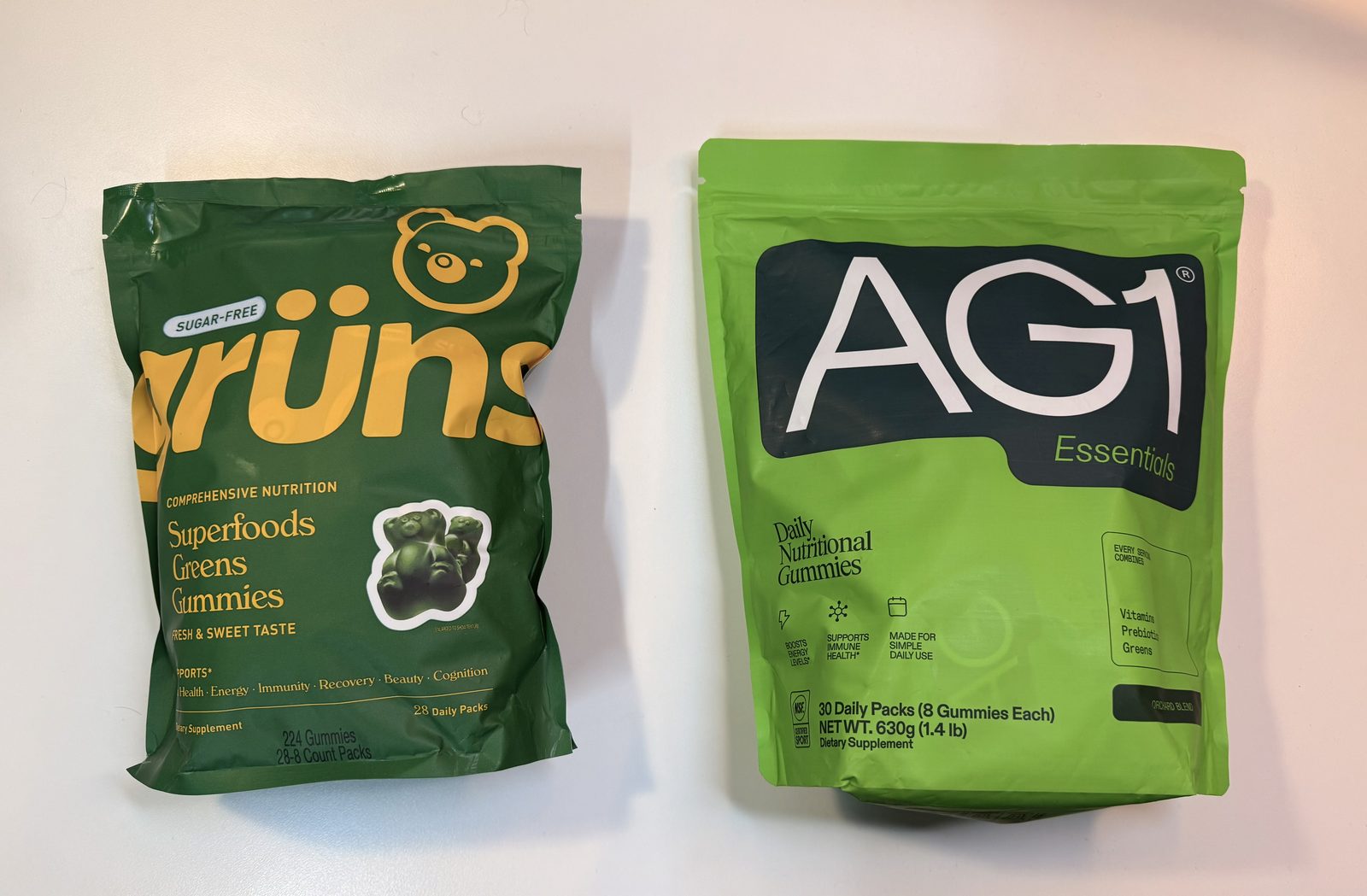
I bought AG1 Essentials Gummies and Grüns Sugar-Free Superfoods Greens Gummies, photographed both bags, transcribed both Supplement Facts panels line by line, and ate them side by side. One has the better formula. The other has the better product. Here is the full comparison: price, ingredients, doses, testing, taste, and who each one is actually for.
Quick answer
| AG1 Essentials Gummies | Grüns Sugar-Free | |
|---|---|---|
| Best for | Tested athletes, taste, lowest DTC price | Zero added sugar, more complete label |
| Subscription | $49 / 30 packs | $54.99 / 28 packs |
| Cost per day | $1.63 | $1.96 |
| Added sugar | 4 g | 0 g |
| Calories | 60 | 20 |
| Fiber | 5 g | 6 g |
| Certification | NSF Certified for Sport | None on the product |
| Prop 65 lead warning | Yes | No |
| Guarantee | 90 days | 30 days |
Short version: Grüns has the better formula. AG1 has the better product. If you are drug tested, buy AG1. If you are avoiding sugar, buy Grüns. If you only care about price, buy Grüns at Costco and ignore both websites.
What is actually going on here
On May 27, 2026, Fast Company ran a piece on the gummy-ification of the supplement industry. AG1 CEO Kat Cole was quoted in it, and she was specific about her own product:
"You can't put AG1, as it is, in a gummy."
Her reasoning was technical and, on its face, correct. The probiotics in AG1's powder "would not survive the heat" of gummy manufacturing. And to carry AG1's full ingredient density into a chewable, she said, "the amount of ingredients would be something like a 15-gummy serving, which is not tenable for the average person."
On August 11, 2026, seventy-six days later, AG1 launched AG1 Essentials Gummies. Eight gummies. One daily pack. Thirty packs to a green bag.
Read Cole's quote carefully and AG1 did not contradict it. She said AG1 as it is could not be a gummy, and AG1 did not try. The gummy carries 50 ingredients where the powder carries 75 or more, and it contains no probiotics: AG1's launch materials list prebiotic fiber only and reserve probiotics for the Next Gen powder. AG1 did not solve the problem Cole named. It shipped a smaller product instead, and gave it a name that says so. Essentials.
Here is the context that makes the timing worth writing about. Grüns launched its greens gummy in August 2023. By August 2025 it was at a reported $300M annualized run rate. On April 9, 2026, Unilever announced it was acquiring the company, and the deal closed June 1, 2026. Unilever never disclosed the price. Forbes reported $1.2 billion, thirty-two months after launch. At acquisition, Unilever's own release described Grüns as the #1 greens supplement on Amazon and in U.S. retail, shipping 10 million gummies a day to more than a million customers.
So the sequence runs: Grüns popularizes the format, Grüns sells for a reported $1.2B, AG1's CEO says AG1's own formula cannot be gummified, AG1 ships a reduced formula as a gummy.
I want to be precise about what I am and am not claiming. I looked for a lawsuit, a trademark opposition, a trade dress dispute, a cease and desist, or a public accusation from Grüns founder Chad Janis. There is none. No trade publication has framed this as copying, and I am not framing it that way either.
In fact, when Inc. asked Janis in February 2026 about rivals adopting the daily sachet format, and the interviewer was the one who raised the names Cleen and Protēn, Janis was generous about it: "I love that there are founders who saw a concept and want to innovate and push the category forward." He has said nothing about AG1.
I will also give AG1 a point that most write-ups of this launch skip: AG1 has sold single-serve daily Travel Packs of its powder since before Grüns existed. The sachet is not a format AG1 borrowed. It got there first in its own category.
What I can do is put the two products next to each other and tell you exactly what they are. Both are greens positioned. Both are eight gummies per serving. Both come in single-serve daily packets. Both sit in a green bag with a daily habit pitch. That is what the rest of this review is about.
The bags

Grüns, left: 224 gummies, 28 daily packs, "SUGAR-FREE" in a white pill on the front, a yellow bear, and the words Comprehensive Nutrition · Superfoods Greens Gummies · Fresh & Sweet Taste. Support claims run along the bottom: Health · Energy · Immunity · Recovery · Beauty · Cognition.
AG1, right: 630g (1.4 lb), 30 daily packs of 8 gummies each, the AG1 wordmark in a black slab, and Daily Nutritional Gummies. Three icons: boosts energy levels, supports immune health, made for simple daily use. An NSF Certified for Sport seal in the corner, and a call-out that every serving combines Vitamins · Prebiotics · Greens.
Two green bags with the same serving architecture. AG1's is the brighter, more supermarket-ready green. Grüns' is the deeper forest green with the friendlier mark. On a shelf next to each other you would read the logo before you read anything else.
One difference on the front panel matters more than it looks like it should: AG1 gives you 30 days per bag. Grüns gives you 28.
The daily packet

This is the closest resemblance between the two products.
Both are flat foil single-serve sachets of roughly the same footprint. Grüns' reads Superfoods Greens Gummies · SINGLE SERVING · SUGAR-FREE. AG1's reads Daily Nutritional Gummies · 8 GUMMIES.
The sachet is the entire behavioral thesis of this category, and it is worth spelling out because it is the reason these products sell. The pack is the dose. There is no scoop, no shaker, no water, no measuring, and no ambiguity about whether you already took it today. A sachet goes in a bag, a gym bag, a carry-on, a glove box. A powder tub stays on a kitchen counter, which is another way of saying it stays home.
The gummies


Here the two products finally diverge, and the close-up shows it.
Grüns is a bear. A properly molded, recognizable gummy bear, noticeably larger than AG1's piece. Nearly black in the hand.
AG1 is a lumpy sphere. Berry-shaped, smaller, denser looking, with a slightly glossy uneven surface. Eight of them make a visibly smaller pile than eight Grüns bears.
Both are far darker than either brand's product photography suggests. If you are expecting the bright green bear printed on the Grüns bag, you are not getting it. That is not a criticism. It is what happens when you put real spirulina, chlorella, and berry powder into a pectin matrix, and it is arguably a good sign.
Taste, texture, and the eight-a-day problem
I ate both. Here is the honest report.
Taste: AG1 by a nose. It is close, not a blowout, but AG1's gummy tastes cleaner. The Orchard Blend strawberry-apple flavor reads as more conventionally like candy, and there is a straightforward reason: AG1 uses cane sugar. Four grams of added sugar buys a flavor experience that non-nutritive sweeteners still cannot fully replicate. Grüns is sweetened entirely with allulose and Reb M stevia. Reb M is the best tasting steviol glycoside available, much less bitter than the Reb A in most sugar-free products, and you can still tell.
Texture: a draw, and not in a flattering way. Both are firm and dense. Neither is a soft, yielding candy gummy. The Grüns bear is bigger so it is more chew per piece. AG1's is smaller but no softer. If you are picturing Haribo, adjust downward. These are supplements that have agreed to be shaped like candy.
The ritual: eight gummies is a lot of chewing. This is the finding I would most want a prospective buyer to hear, because neither brand will tell you. Eight dense gummies is not a bite, it is a full minute of deliberate jaw work, several times the volume of a typical two-gummy multivitamin. It is entirely doable, and it is unquestionably easier than mixing a powder and then washing the shaker. But fun is doing some work in both brands' marketing. Call it pleasant and slightly effortful, every single day, indefinitely.
The honest framing: the gummy format does not make a daily supplement delightful. It makes it portable and hard to skip, which is the thing that actually drives compliance.
Price: the full breakdown
All prices verified on drinkag1.com, gruns.co, and costco.com on August 21, 2026. Prices in this category move often.
| AG1 Essentials Gummies | Grüns Sugar-Free | |
|---|---|---|
| Packs per bag | 30 | 28 |
| Gummies per bag | 240 | 224 |
| One-time price | $64 plus $5 shipping ($69 landed) | $73.32 |
| Subscription | $49 (save 23%) | $54.99 (save 25%) |
| Subscription shipping | Free | Free |
| Billing cycle | Every 30 days | Every 28 days |
| Cost per day | $1.63 | $1.96 |
| Cost per gummy | $0.20 | $0.25 |
| 3-month prepay | $129 / 90 days = $1.43/day | Not published pre-cart |
| Money-back guarantee | 90 days | 30 days |
Both brands bill sub-monthly, which is worth understanding before you subscribe. AG1 charges every 30 days, so about 12.2 times a year. Grüns charges every 28 days, so about 13 times a year. Neither is twelve.
Annualized:
- AG1: about $596/year
- Grüns Sugar-Free: about $717/year
- Difference: roughly $121/year
On a per-day basis AG1 is about 17% cheaper, or put the other way, Grüns costs about 20% more. Prepay AG1 quarterly at $1.43/day and the gap widens to 27%.
Two caveats that cut the other way:
1. Grüns has a cheaper sibling. Grüns Low Sugar is $49.99 on subscription, which is $1.79/day and about $650/year. Still more than AG1, but much closer.
2. Costco changes everything. Grüns sells a 35-pack adult bag at Costco for $39.99 (item #2025322), discounted to $31.99 as of this week. That is $1.14/day, or $0.91 on promo, roughly half the DTC subscription price and comfortably cheaper than AG1 at any tier. It is the original formula rather than the sugar-free one, and you are buying a membership and a fixed cadence. But if price is your deciding variable, the answer is not AG1 or gruns.co. It is Costco.
One more number for scale. AG1's own powder is $79/month on subscription, or $2.63/day. The gummy is 38% cheaper per day than the powder from the same company, with 50 ingredients instead of 75 or more, and no probiotics. AG1 has launched a cheaper, lighter version of itself.
Before you subscribe to either: AG1 is facing a proposed class action, Hoke v. AG1 (USA), Inc., case 2:26-cv-01110, filed February 3, 2026 in the Central District of California, alleging that it enrolls customers in auto-renewing subscriptions using dark patterns in violation of California's Automatic Renewal Law. These are allegations, not findings. AG1's terms say you can cancel at any time, electronically through its help portal or by phone at 1-888-390-4029. Grüns states "pause or cancel any time." Read the checkout screen carefully on both sites.
Ingredients: the full label, dose by dose

I transcribed both Supplement Facts panels off the physical bags and cross-checked them against each brand's published formula. Serving basis: AG1 is 8 gummies (21g), Grüns is one 8-count pack (20g).
| Nutrient | AG1 Essentials | %DV | Grüns Sugar-Free | %DV |
|---|---|---|---|---|
| Calories | 60 | 20 | ||
| Total carbohydrate | 16 g | 6% | 15 g | 5% |
| Dietary fiber | 5 g | 18% | 6 g | 21% |
| Total sugars | 5 g | <0.5 g | ||
| Added sugars | 4 g | 8% | 0 g | 0% |
| Sodium | 50 mg | 2% | not listed | |
| Vitamin A (retinyl palmitate) | 750 mcg RAE | 83% | 900 mcg RAE | 100% |
| Vitamin C (ascorbic acid) | 200 mg | 222% | 93 mg | 103% |
| Vitamin D3 (cholecalciferol) | 20 mcg | 100% | 20 mcg | 100% |
| Vitamin E | 15 mg | 100% | 15 mg | 100% |
| Thiamin (B1) | 1.2 mg | 100% | 1.2 mg | 100% |
| Riboflavin (B2) | 2 mg | 154% | 1.3 mg | 100% |
| Niacin (B3) | 12 mg NE | 75% | 16 mg NE | 100% |
| Vitamin B6 (pyridoxal-5-phosphate) | not listed | 1.7 mg | 100% | |
| Folate (5-MTHF) | 400 mcg DFE | 100% | 400 mcg DFE | 100% |
| Vitamin B12 (methylcobalamin) | 2.4 mcg | 100% | 2.4 mcg | 100% |
| Biotin | not listed | 30 mcg | 100% | |
| Pantothenic acid (B5) | 5 mg | 100% | 5 mg | 100% |
| Choline | 20 mg | 4% | not listed | |
| Iron (ferrous fumarate) | not listed | 4.5 mg | 25% | |
| Phosphorus | 60 mg | 5% | not listed | |
| Iodine (potassium iodide) | 38 mcg | 25% | 38 mcg | 25% |
| Magnesium (glycinate, malate) | 20 mg | 5% | not listed | |
| Zinc (citrate) | 7 mg | 64% | 2.75 mg | 25% |
| Selenium (sodium selenite) | not listed | 14 mcg | 25% | |
| Copper | 0.2 mg | 22% | 0.225 mg | 25% |
| Manganese | 0.4 mg | 17% | 0.575 mg | 25% |
| Chromium (chloride) | not listed | 9 mcg | 26% | |
| Molybdenum | 45 mcg | 100% | 11 mcg | 24% |
| Potassium | 100 mg | 2% | not listed | |
| Vitamin K2 | 120 mcg (MK-7) | 100% | 120 mcg (form not stated) | 100% |
| Proprietary blend | 8.9 g | 8.67 g | ||
| Third-party product certification | NSF Certified for Sport | None |
The two formulas follow opposite philosophies
Grüns is a metronome. Twelve vitamins at 100% DV, with vitamin C the lone outlier at 103%. Eight minerals at or near 25% DV. Nothing meaningfully above 100%. It is a deliberately conservative insurance policy: cover the floor, never megadose.
AG1 is uneven. Vitamin C at 222%, riboflavin at 154%, molybdenum at 100%, vitamin A at 83%, niacin at 75%, zinc at 64%, and then a cluster of minerals sitting at 2% to 5% DV. There is no single organizing logic to it.
Which brings me to the trap in this table. AG1 lists five nutrients Grüns does not: choline, phosphorus, magnesium, potassium, and sodium. That sounds like an advantage until you read the doses. Choline 4%. Phosphorus 5%. Magnesium 5%. Potassium 2%. Twenty milligrams of magnesium is less than you would get from a slice of whole grain bread. These are label decorations, not functional doses.
Grüns' five exclusives, B6, biotin, iron, selenium, and chromium, are at 25% to 100% DV. Doses that do something.
The count favors AG1. The pharmacology favors Grüns.
Nutrient forms: both are better than the category
Neither product uses folic acid, cyanocobalamin, magnesium oxide, or zinc oxide. Both use 5-MTHF folate and methylcobalamin B12, which is genuinely above average and both deserve credit for it.
Grüns has the single best form on either label: pyridoxal-5-phosphate, the activated coenzyme form of B6. It also has the two worst: sodium selenite (inorganic, where selenomethionine absorbs better) and chromium chloride (absorbed at roughly 0.5%).
AG1's mineral chelates look better on paper, magnesium glycinate and amino acid chelate manganese, but good forms at 5% DV is not a win. AG1's K2 is confirmed as MK-7. Grüns does not state its K2 form on the bag, which is a small but real transparency gap.
One genuine coincidence: both land on iodine at exactly 38 mcg, 25% DV. I checked twice on each label because I assumed I had made a transcription error. I had not.
What is actually in the "blend"
Both products headline a big number. AG1's 8.9 g "Vegetable, Fruit, and Prebiotic Complex" across 28 ingredients. Grüns' 8,670 mg "Core Nutrients Blend" across 31.
Neither company discloses a single individual ingredient amount. Both are proprietary blends. That is the central fact and it applies equally, so nobody wins this round on transparency.
Here is the subtraction anyone can do at a kitchen counter.
AG1 declares 5 g of fiber and lists tapioca fiber and inulin (chicory root) as ingredients #1 and #2. Since blend ingredients must be listed in descending order by weight, those two prebiotic fibers are the largest components of the 8.9 g. Grüns declares 6 g of fiber against an 8.67 g blend.
Subtract the fiber:
- AG1: 8.9 g minus 5 g = 3.9 g of plant powder across 28 ingredients, about 140 mg each
- Grüns: 8.67 g minus 6 g = 2.67 g across 31 ingredients, about 86 mg each
Registered dietitian Avery Zenker ran this same math on Grüns for Forbes Health: since the blend adds up to 8.7 grams and 6 grams of that is fiber, "that leaves 2.7 grams or more for the rest of the ingredients." The proprietary blend, she notes, "makes it impossible to know exactly how much of each ingredient is present, and whether the doses are at clinical effectiveness."
What does 100 mg of vegetable powder actually deliver? Dehydration concentrates plant matter roughly five to ten times by weight, so you are looking at half a gram to a gram of fresh vegetable equivalent per ingredient. A serving of broccoli is about 80 grams. The broccoli in either of these products is therefore on the order of 1% of a serving of broccoli.
And here is the part neither label says out loud. Every micronutrient with a %DV on either panel is an added, isolated, or synthetic form. Ascorbic acid. Cholecalciferol. Zinc citrate. Ferrous fumarate. None of the declared vitamin and mineral content comes from the greens. The greens contribute polyphenols, carotenoids, and chlorophyll at undisclosed and almost certainly sub-clinical doses.
Grüns concedes the point on its own website: its products, "though nutritious, should not replace whole foods." That is the correct and honest position, and it applies to AG1 identically.
What you are buying in both cases is a well-formed multivitamin plus 5 to 6 grams of prebiotic fiber, wearing a superfood costume. That is a genuinely useful product. It is not vegetables.
One oddity for the label readers: on the physical Grüns bag I photographed, the Core Nutrients Blend lists the greens first and inulin and tapioca fiber last, while several retailer listings of the same product show the fiber first. Descending order rules mean both orderings cannot be right, and neither tells you the split. The 8.67 g headline number carries almost no usable information.
A formulation risk that applies to both: a gummy is a chemically unstable home for micronutrients. As registered dietitian Rachel Gargano has pointed out, gummies are "packed with gel-forming compounds to maintain their structure, leaving little room for plants and other supplements," and "gummies are known to be an unstable environment for vitamins and minerals, so consumers may be getting higher or lower amounts than what is stated on packaging." Neither company publishes shelf-life overage data. This is a real, under-discussed cost of choosing the format at all, and it is the strongest evidence that Kat Cole's May position was technically right even as her company shipped anyway.
The lead warning, and the paradox nobody explains
Look at the back of the AG1 bag in the photo above and you will find this, boxed, at the bottom left:
WARNING: Risk of reproductive harm from exposure to lead. P65Warnings.ca.gov/food
The Grüns bag carries no such warning. It carries the standard iron overdose warning required of any iron-containing supplement, plus a caution for children and pregnant or nursing women. No Prop 65.
The obvious reading is that AG1 is dirtier. That reading is probably wrong, and the real explanation is more useful.
California's Prop 65 threshold for lead as a reproductive toxicant, the Maximum Allowable Dose Level, is 0.5 micrograms per day. That is among the strictest thresholds in the world, and it is dramatically stricter than the daily lead limits set by U.S. Pharmacopeia or NSF for dietary supplements. A product can pass USP and NSF comfortably and still trip Prop 65. AG1's position that its heavy metals sit below USP and NSF guidelines, and the presence of the warning, are both true simultaneously and are not in conflict.
Lead in these products is not added. It is taken up from soil by leafy greens, root vegetables, and algae. Spirulina and chlorella are repeat offenders, and both products contain both.
So: two products drawing on similar categories of leafy green, algae, and root vegetable supply chains. One carries the warning, one does not. A warning label is evidence of disclosure, not evidence of contamination, and its absence is not evidence of cleanliness. More likely than not, the difference here reflects legal posture rather than lead content.
What I hold against AG1 is not the warning. It is the dodge. AG1's own FAQ explains Prop 65 by saying it "requires a warning label if a product may expose consumers to any of over 900 substances, many of which occur naturally in foods from the earth, like fruits, vegetables, and herbs." AG1 never names lead. The bag does. The FAQ will not.
Now the paradox, and it is a real one.
AG1 carries the lead warning and the stronger certification. NSF Certified for Sport is an auditable, batch-level credential screening for more than 280 substances banned in professional sport. It is the most meaningful third-party mark in this category, and AG1 carries it on the gummy specifically.
Grüns carries no warning and no product certification. It manufactures in NSF-registered facilities, but facility registration certifies the plant, not the batch. There is no NSF Certified for Sport, Informed Sport, or USP mark on the product. Forbes Health reports that Grüns posts third-party heavy metal testing from Light Labs on its site, and Forbes commissioned its own independent screen through Alkemist Labs covering arsenic, cadmium, mercury, lead, plus microbials and pesticides, which passed at safe levels. That is meaningful. It is not the same as a standing certification.
If you are drug tested, AG1 is the only one of the two that most sports programs would clear.
Two things that get misreported constantly, so let me be exact:
- ConsumerLab's 2022 lead finding about AG1 is about the powder, not the gummy. It concluded that regular use of the powder should be avoided by children and women who may be pregnant. Nobody has independently tested the gummy.
- No Clean Label Project report exists for either of these products. If you see one cited, it is about something else.
Why the Grüns label looks like magic (it is a labeling rule)
Grüns declares 15 g of total carbohydrate and 20 calories. That is arithmetically impossible under normal accounting, since 15 g of carbohydrate at 4 kcal/g is 60 calories on its own.
The answer is allulose, and one specific FDA decision.
In final guidance issued October 16, 2020, the FDA exercised enforcement discretion to exclude allulose from both Total Sugars and Added Sugars on nutrition labels, while still counting it toward Total Carbohydrate, and allowed manufacturers to calculate it at 0.4 kcal/g instead of 4.
Run it on the Grüns panel. Subtract 6 g of fiber and about 0.5 g of sugar from 15 g of total carbohydrate and roughly 8.5 g is unaccounted for. At allulose's 0.4 kcal/g that is only about 3.4 kcal, which fits comfortably inside the calorie budget the panel leaves open. So: roughly 9 grams of allulose per pack. That is my inference from label arithmetic, not a disclosed figure.
The "only 1 g of net carbs" claim on the front of the bag works the same way. Fifteen grams of total carb minus 6 g of fiber is 9 g. You only reach 1 g by also subtracting the allulose. That is a defensible industry convention, since allulose is largely unabsorbed and does not meaningfully raise blood glucose. It is also a generous calculation, and you should see the arithmetic before you accept it.
None of this makes Grüns worse. Zero added sugar and 20 calories is a real advantage over AG1's 4 g and 60 calories, especially if you are on a GLP-1, managing glycemia, or simply do not want to spend a daily sugar allowance on a supplement. It is just worth knowing that the label looks miraculous because of a regulatory decision, not a formulation breakthrough.
On tolerance: roughly 9 g of allulose is well below the level that causes trouble. The controlled data (Han et al., Nutrients, 2018) puts the safe single dose at 0.4 g per kg of body weight, about 28 g for a 70 kg adult. Reb M is a permitted sweetener with a JECFA acceptable daily intake of 0 to 4 mg/kg body weight per day expressed as steviol; the dose in a gummy is almost certainly a small fraction of that, though Grüns does not disclose the amount.
If either product makes you gassy, the likely culprit is the 5 to 6 grams of inulin and tapioca fiber, not the sweetener. Inulin is a fermentable FODMAP and is the most common source of bloating complaints in this entire category. It applies to both products about equally, so it is not a differentiator. If you are sensitive, start with half a pack for a week.
Who each one is for
Buy AG1 Essentials Gummies if:
- You are drug tested. NSF Certified for Sport is the whole argument, and Grüns has no product-level equivalent. This alone decides it.
- You want the cheapest direct-to-consumer option. $1.63/day, $1.43 on quarterly prepay, about $596/year.
- You want the higher single doses. 2.2x the vitamin C, 2.5x the zinc, 4x the molybdenum, more riboflavin.
- You care about taste more than sugar. The cane sugar makes it the better tasting product. Four grams is about a teaspoon.
- You want a bigger safety net on the purchase. Ninety-day money-back guarantee versus thirty.
- You already use AG1 and want the daily ritual without the shaker at 38% less per day.
Buy Grüns if:
- You want zero added sugar. 0 g versus 4 g, 20 calories versus 60. On a GLP-1, tracking glycemia, or cutting added sugar, this is the whole ballgame.
- You want completeness at doses that matter. Iron, B6, biotin, selenium, and chromium at 25% to 100% DV. AG1 has none of them.
- You want a predictable formula. 100% DV vitamins, 25% DV minerals, nothing megadosed.
- You shop at Costco. $1.14/day, or $0.91 on promo, beats everything else in this review by a wide margin.
- You want slightly more fiber. Six grams versus five.
- You prefer the bear. It is, objectively, a nicer object.
Buy neither if:
- You think either replaces vegetables. Under 4 grams of plant powder across roughly 30 ingredients is not a serving of anything. Grüns says as much itself.
- You already take a good multivitamin and eat fiber. You would be paying $600 to $720 a year for overlap.
- You take a separate iron supplement or a fat-soluble A/D/E/K stack. Check for stacking against Grüns in particular, which carries 4.5 mg of iron.
- You want probiotics. Neither gummy has any, because they do not survive the manufacturing.
The verdict
Grüns has the better formula. AG1 has the better product.
Grüns wins on everything a nutritionist would score: zero added sugar, a third of the calories, more fiber, five additional nutrients at doses that actually do something, the best nutrient form on either label, and a formulation logic you can explain in one sentence.
AG1 wins on everything a buyer actually experiences: it tastes better, it costs about $121 less a year, it gives you 30 days per bag instead of 28, it comes with a 90-day guarantee instead of 30, and it carries the only real product certification in this comparison.
If you are drug tested, buy AG1. NSF Certified for Sport ends the argument.
If you are avoiding sugar or you want the more complete label, buy Grüns.
If you only care about price, buy Grüns at Costco and ignore both websites.
And if you want my personal read after eating both: what you are paying $600 to $720 a year for is a competent multivitamin, 5 to 6 grams of prebiotic fiber, and a delivery format engineered so that you actually take it. Whether that last part is worth the premium depends entirely on how many half-finished tubs of greens powder are already sitting on your counter. For a lot of people, honestly, it is.
The larger lesson is the one worth taking away from this whole episode. Grüns went from launch to a reported $1.2 billion deal in thirty-two months by understanding one thing before the incumbent did: the hard part of a daily supplement was never the formula. It was getting you to take it every day. Eight bears in a sachet beat a scoop and a shaker you have to wash. Everyone in this category now agrees, including the company whose CEO said its own formula could not be made to fit.
Methodology and disclosures
I bought both products at retail. Every nutrient value in the table above was transcribed from the physical bags photographed in this article and cross-checked against each brand's published formula. Where the two disagreed, I used the bag. All prices were verified on drinkag1.com, gruns.co, and costco.com on August 21, 2026, and prices in this category change frequently.
I have no commercial relationship with either company, and this review contains no affiliate or referral links. Nobody paid for placement in it, and I make nothing if you buy either product.
Corrections welcome. If you work at AG1 or Grüns and I have a number wrong, tell me and I will fix it.
Ari Tulla is the Co-founder and CEO of Elo Health, the smart nutrition company turning food into medicine. He treats his body as a living laboratory, rigorously testing every new protocol, wearable, diagnostic, and, apparently, gummy bear to decode the science of longevity. When he is not reading Supplement Facts panels with a magnifying glass, you can find him climbing mountains or riding gravel in Northern California.
Share:
I Replaced My Cycling Coach with Claude. Then I Rode Unbound 100 Through the Mud.