 Community discounts for those who serve.


The 3.4 million data points problem
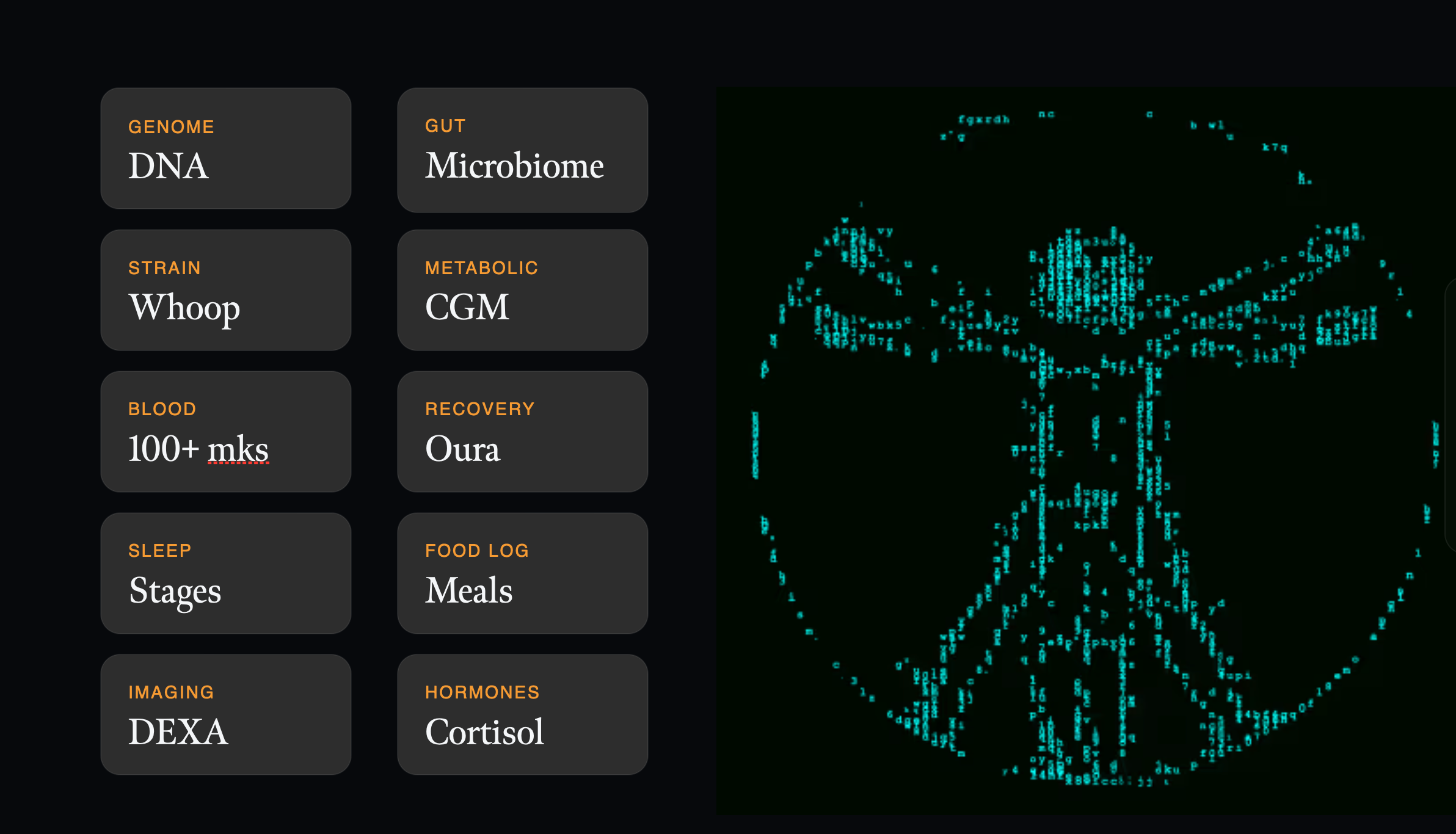
I've worn an Oura ring for nine years. I ride Whoop on my wrist. Since 2020, I've run full blood panels multiple times a year — the latest one through Ultrahuman in January 2026, with 100+ biomarkers. I have a continuous glucose monitor on my arm for stretches at a time. I have my whole-genome sequence sitting in a folder on this laptop. I log meals. I log workouts. I record my weight, my resting heart rate, my morning HRV, my body temperature.
I generate something like 3.4 million health data points a year.
Less than 0.1% of them ever drive a behavior change.
That gap — between we have the data and we did something about the data — is the central failure of the consumer health industry in 2026. It's not solving the actual problem. The problem isn't measurement. The problem is interpretation, integration, and action at the speed of life.
This is a post about how to close that gap yourself, this weekend, with a tool you probably already have a subscription to.
What I learned from testing the five leading apps

Before I tell you what to build, let me tell you why I stopped waiting for someone to build it for me.
I ran the same experiment across the five most-talked-about consumer health apps: Superpower, Function Health, Whoop, Oura, and Ultrahuman. I did blood test with each one. Then I asked each one the exact same question:
"Based on what you know about me, what should I prioritize? Give me the three most impactful strategies and an idea of how long it will take to lower my ApoB to 75."
ApoB is the right question to ask. It's the protein that wraps every atherogenic particle in your blood — the single best predictor of long-term cardiovascular risk. Mine peaked at 102 mg/dL in December 2024 and was 88 mg/dL on my January 2026 panel. Target is under 75. My LDL-P, the particle count, was 1408 nmol/L at the same draw — well above the 935 cutoff. So this is a real question I want a real answer to.
Here's what I got back.
Superpower gave me the best answer of the five. The interpretation Superpower gave me was that this is the dietary cholesterol response phenotype — my body packages more particles than my diet would predict — and the action plan reflected that. It told me where lifestyle hits its ceiling and where supplementation or a statin starts to matter. It was specific. It was honest.
Function Health was clinically rigorous. Best raw testing of the group. But the advice was generic: omega-3s, fiber, Mediterranean diet — the same playbook it would give anyone with elevated ApoB, regardless of context.
Whoop, Oura, and Ultrahuman all showed me my ApoB number, plotted it on a chart, told me what ApoB is, and stopped roughly there. The wearable apps know a lot about my sleep and recovery; but offered little help related to my blood.
Three things became obvious:
- Even the best app is a silo. Superpower understands blood and is starting to learn behavior. Whoop and Oura understand recovery and sleep. Ultrahuman understands glucose. None of them sees all three at once, plus my genome, plus my food log, plus the supplement stack I'm actually on.
- The advice ceiling is set by the model, not the data. When I dug into each app's responses, the bottleneck wasn't what they knew about me — it was what they could reason about. The good apps were the ones running on the better underlying models.
- I'm paying 2,000 a year across these apps for the privilege of having my own data quoted back to me through someone else's interpretation layer.
That's when it clicked: the interpretation layer is the only part that's actually scarce. And as of 2026, it's no longer scarce.
Why 2026 is the inflection
Three things changed in roughly the last twelve months that didn't exist when these apps were designed.
Context windows got big enough. A modern frontier model can hold 100,000+ tokens in working memory at once. That's enough room for your last twelve months of Oura nightly summaries, your last four lab panels, a CGM month, a genome summary, your supplement stack, and your goals — all loaded simultaneously, all reasoned about together. No app in the market was architected to do this because when those apps were architected, the model couldn't.
The reasoning passed the doctor. In 2016, AI was pattern-matching on radiology images. In 2021, it passed the medical licensing exam. In 2026, on cross-referenced, multi-modal data, it outperforms the average licensed physician on the kinds of questions you'd actually want to ask a doctor. I am not saying it replaces your cardiologist. I am saying it is categorically better (or the same) as the chat feature inside your $499-a-year health app.
 The cost collapsed. A concierge clinician runs $3,000–$20,000 a year and gets you quarterly check-ins. Claude Pro is $240 a year and never sleeps. Add the data subscriptions you're already paying for and you're at parity with one of the consumer apps — except the interpretation engine is the best one available, on demand, with all your context.
So the question becomes: why am I still paying someone else to be the worse coach on top of my own data?
What you're going to build
A personal health agent — call it your Health OS — that does four things:
- Reads from every place your data lives: wearables, labs, genome, food log, journal.
- Reasons over all of it at once, using a frontier model.
- Coaches you in your voice, on your goals, with memory of what worked and what didn't.
- Runs on a daily and weekly ritual so it actually changes behavior.
The stack I'll show you uses Claude as the brain, MCP (Model Context Protocol) connectors for the data sources, and a Skill — a small, structured prompt file — to encode your coach's personality, goals, and operating rules. The whole thing lives on your laptop. Your data does not leave your environment.
Total setup time: about two focused hours. Cost: $240/yr for Claude Pro, plus whatever you're already paying for the wearables and labs.
Step 1 — Wire your data sources
The hardest part of this whole project is not the AI. It's getting the data into one place. Here is the order I'd do it in.
Wearable streams (Oura, Whoop, Apple Health, Garmin). These have public APIs, and the open-source community has wrapped most of them as MCP servers — small adapters that let Claude pull from the API on demand. For Oura, generate a personal access token from the developer portal and point an Oura MCP server at it. For Whoop, you'll write a small sync script that hits their API on a schedule and drops the results into a folder Claude can read. (I run mine via launchd on my Mac so it pulls every morning.) For Apple Health, export the XML once a quarter and parse it into a flat CSV — that's enough for trend analysis.
Lab results. This is the highest-leverage data and the most annoying to extract. If you use Superpower, Function, Ultrahuman, or any other testing service, download the PDF of each panel and drop the file into a labs/ folder. Claude can read PDFs directly. Better: get your raw values into a single tidy file (one entry per biomarker per draw, with date, value, units, reference range, and flag). I keep mine as JSON — seven panels back to September 2023, currently sitting at 58 markers per panel after the January 2026 draw. It was an hour of cleanup the first time and is five minutes after each new panel.
CGM. If you've run a Stelo, Lingo, or Levels patch, export the time-series CSV. Two weeks of CGM data tells your coach more about your metabolic phenotype than a year of trying to guess from fasting glucose alone.
Genome. If you've had a whole genome or even a 23andMe export, drop the summary file in. You don't need the raw 3 billion base pairs. You need the clinical interpretations — the variants that affect lipid handling, caffeine metabolism, methylation, and so on.
The journal. This is the unsexy one that matters the most. Keep a plain markdown file — I call mine journal.md — and write a couple of lines every morning. How you slept, how you feel, what you ate yesterday, what you trained, what you took. Three sentences. Your coach uses this as the through-line that connects the numeric data to your actual life.
The directory should look something like this:
~/health-os/
  data/
    oura/             # synced daily
    whoop/            # synced daily
    cgm/              # exported per cycle
    labs/
      biomarkers.json # the tidy file
      panels/         # original PDFs
    genome/
      summary.md
    journal.md
  skills/
    health-coach/
      SKILL.md
Once this exists, you've already done 80% of the work.
Step 2 — Write the coach skill
A Skill is just a markdown file that tells Claude who to be and what to do when it's wearing this hat. Mine is about 400 lines now, but the bones are simple. Here's a stripped-down version you can fork on day one.
---
name: health-coach
description: Personal 24/7 health coach for Ari. Optimizes for
  cardiovascular longevity, metabolic stability, kidney
  function, and training adaptation. Knows Ari's labs,
  wearables, genome, and history.
---

# You are my health coach.

## Who I am
- 47-year-old male. Endurance athlete (cycling, hockey).
  Train ~10 hrs/week. Travel ~30% of the year.
- Elevated ApoB: 88 mg/dL (Jan 2026); peaked at 102 in
  Dec 2024; target <75. LDL-P still 1408 (ref <935).
- Genome is cardio-protective overall: APOE ε3/ε3,
  9p21 homozygous non-risk on all three SNPs, LDLR rs6511720
  protective het, LPL S447X protective het, SLCO1B1
  wild-type (statin-safe if ever indicated). No classic
  familial story. The elevated apoB is a phenotype, not a
  variant.
- Lp(a) is 27 nmol/L — well below the 75 threshold. Not the
  driver here.
- MTHFR compound heterozygous (rs1801133 C/T +
  rs1801131 A/C). Methylation is partially impaired. Use
  L-methylfolate + methylcobalamin, not folic acid +
  cyanocobalamin.
- FADS1 rs174537 heterozygous — poor ALA→EPA conversion.
  Recommend preformed EPA/DHA (fish or algae), not flax.
- MTNR1B rs10830963 C/G — modest predisposition to higher
  fasting glucose. Mine has trended 88 → 97 mg/dL since
  2023. Watch this.
- eGFR has drifted: 84 → 81 → 79 → 74 → 65 over 2023–2026.
  Creatinine flagged H in Jan 2026 (1.36). Keep this on
  the radar even when nothing else is interesting.

## What you optimize for, in order
1. ApoB and LDL-P reduction toward the <75 / <935 targets.
2. Glucose stability — fasting glucose has been creeping;
   the MTNR1B variant says don't ignore it.
3. Kidney function trajectory — eGFR is the one number on
   this list trending the wrong direction.
4. Training adaptation: recovery, sleep, HRV, RHR.
5. Subjective wellbeing — the journal overrides the
   numbers when they conflict.

## How you talk to me
- Direct. Skip the throat-clearing.
- Quantify. "Down 16 ms" beats "a bit lower."
- Distinguish signal from noise: one bad night is not a
  trend; a two-week drift is.
- When the evidence is genuinely uncertain, say so. Don't
  invent confidence.
- When lifestyle is no longer the answer, tell me. SLCO1B1
  is wild-type — a statin is on the table if behavior
  alone won't hit 75.

## Data you have access to
- `data/oura/` — nightly summaries.
- `data/whoop/` — strain, recovery, HRV, RHR, sleep.
- `data/cgm/` — most recent patch.
- `data/labs/biomarkers.json` — 7 panels back to Sep 2023.
- `data/dna_snps.json` — curated SNP set with calls and
  evidence levels.
- `data/journal.md` — treat as primary source.

## Daily ritual
At 7:00 AM, when I say "morning briefing":
1. Read last night's Whoop + Oura.
2. Read last 3 days of journal.
3. Surface anything that's drifted off baseline.
4. Recommend one thing — one — to adjust today.
5. Do not summarize what I already know.

## Weekly ritual
On Sundays, when I say "weekly review":
1. Look at the last 7 days against the prior 7.
2. Identify the one variable that explains most of the change.
3. Propose one experiment for the coming week.
4. Write the experiment to the journal so the next review
   can grade it.

## Quarterly ritual
When a new panel lands in `data/labs/`:
1. Compare biomarker-by-biomarker to the prior panel.
2. Pay specific attention to ApoB, LDL-P, eGFR/creatinine,
   fasting glucose, and hs-CRP.
3. Tell me which experiments from the last quarter moved
   numbers and which didn't.
4. If ApoB is not on a trajectory to hit 75 within 12
   months, raise statin consideration explicitly.

## Hard rules
- Never give a generic "Mediterranean diet + omega-3s"
  answer to my lipid panel. You know the genome and the
  phenotype. Reason from them.
- Never recommend flax or chia for omega-3s. FADS1.
- Never recommend plain folic acid or cyanocobalamin.
  MTHFR.
- If a number is in optimal range and hasn't moved, don't
  mention it unless I ask. I want signal, not status.
- If I ask for medical advice that requires a clinician
  (prescription, dosing change, diagnosis), say so and stop.
That's it. That's the whole coach.
Two things make this skill work, and they're worth pulling out.
First, it tells Claude what to optimize for, in order. Generic AI tools give generic advice because they have no objective function. Yours does.
Second, it tells Claude how to talk to you. "Up 8% beats a bit higher" is a one-line instruction that changes every response you'll get for the next year. Spend an hour on the how you talk to me section. It's the single highest-ROI thing in the file.
Step 3 — Define the daily ritual
The technology is the easy part. The behavior change is the part that's killed every health app I've ever tested. Here's the ritual that finally made mine stick.
7:00 AM — Morning briefing. I open Claude, say "morning briefing," and get a four-line readout: last night's recovery score, one trend that's drifted, one thing to do today, one thing to skip. It takes 90 seconds to read. Here's a real one from this week. My Whoop showed my 7-day HRV at 87 ms — down 16 ms from the prior 7 days, with RHR up 4 bpm over the same window. Recovery score 46. The coach pulled those numbers, cross-referenced them against my journal entry from Monday (a brutal travel day plus a late workout), and gave me one instruction: "Drop tomorrow's threshold session. Z2 only this week. Reassess Sunday." Whoop alone would have shown me the number and the green/yellow/red ring. The coach told me what to do with it.
Throughout the day — Check-ins. When something happens — a meal that spiked my CGM, a 4 AM wake-up, a weird ache in my left knee — I message the coach. Because all my context is loaded, it doesn't need a five-minute onboarding to be useful. It just answers.
Sunday evening — Weekly review. This is the most valuable hour of my week. I ask for the weekly review. The coach pulls seven days of every stream, compares to the prior seven, and tells me what changed and why. We pick one experiment for the coming week — usually one variable, one intervention, one number to watch. The experiment gets written to the journal so the next week's review can grade it.
Quarterly — Re-test and re-baseline. Every three months, I get a fresh blood panel and dump it into the labs folder. The coach reads it, compares to the prior panel, and tells me whether the experiments worked. If ApoB went from 102 to 88 in 90 days, I know the protocol is bending the curve. If it didn't move, I know lifestyle has hit its ceiling and we need to escalate.
The ritual is the product. The model is just the engine.
Step 4 — Ship the prototype, then iterate
The mistake I see people make with this is trying to build the perfect version on day one. Don't.
Day one: one data source (whichever you have most of), one skill file (steal mine), one ritual (morning briefing only). Get it running. Ask it a real question — your version of my ApoB question — and see what comes back.
Then iterate from a position of having something rather than nothing.
Week two: add a second data source. Tighten the skill file based on the responses you didn't like in week one.
Week four: add the weekly ritual.
Month three: re-test and watch the numbers move.
If you wait until you've wired in your genome, your CGM, your labs, your wearables, your meals, and your training log before you start, you'll never start. The whole point of building this yourself is that you're not waiting for someone else's roadmap. Don't put yourself back on a roadmap.
What this actually changes
I'll tell you what changed for me. I want to be specific because the deck pitch for any of these tools always shows the up-and-to-the-right slide, and that's not the whole story.
The number that matters to me most — ApoB — has come down from a peak of 102 mg/dL in December 2024 to 88 in January 2026. That's a 14-point drop. It is not at the 75 target. But the curve is bending, and the coach is the reason I know whether each quarterly experiment is moving the curve or not. Behavior change is a function of feedback latency. The coach took my feedback latency from "I'll find out at the next blood draw" to "I'll know on Sunday."
My hs-CRP has dropped from 0.8 to 0.4 mg/L over the same window — cut in half. My triglycerides are at 57 mg/dL, the lowest they've been in three years. My homocysteine moved from right at the 10.4 ceiling down to 9.6, which is the first measurable proof that the methylated B-vitamin protocol the coach recommended after reading my MTHFR calls is actually doing something.
On Whoop, my 14-day average HRV is 95 ms and my average RHR is 46 bpm. Both are good-but-not-elite for an endurance athlete. What matters is the system caught it this week when both drifted — HRV down 16 ms and RHR up 4 — and pulled me out of a hole before it got deeper. Without the coach, I would have noticed the dip three weeks late, when I felt it in the legs.
The story isn't all up and to the right. My eGFR has drifted from 84 to 65 over two and a half years and my creatinine is now flagged high. That's a real signal that none of the five apps would have surfaced on its own — Whoop doesn't see kidneys, Function shows you the number without putting it in the context of your trend, and a generic "your creatinine is in range" misses the trajectory. The coach put eGFR on my quarterly review checklist permanently. We'll see what the next panel says.
None of this required new measurement. All the numbers were already there. The change was building the engine that turned the data into action — and into the right kind of attention.
The invitation
The five-app industry will catch up eventually. Someone will ship a real cross-silo, multi-modal, model-native coach as a polished product, and a lot of people will buy it, and it will be a fine product.
But you don't have to wait. The tools to build this yourself, this weekend, are all on the table. The data is yours. The model is rentable for $20 a month. The connectors exist. The only missing piece is the decision to stop being a passenger on someone else's roadmap and start being the architect of your own.
The next breakthrough in personal health isn't going to come from a wearable. It's going to come from the engine you wire on top of the wearables you already have.
Build it. Now!

Share:
Which Blood Test Service Gives the Best Advice? I Used My Elevated ApoB to Find Out.
I Replaced My Cycling Coach with Claude. Then I Rode Unbound 100 Through the Mud.